library(dcmdata)

ecpe_data
#> # A tibble: 2,922 × 29
#>    resp_id    E1    E2    E3    E4    E5    E6    E7    E8    E9   E10   E11
#>      <int> <int> <int> <int> <int> <int> <int> <int> <int> <int> <int> <int>
#>  1       1     1     1     1     0     1     1     1     1     1     1     1
#>  2       2     1     1     1     1     1     1     1     1     1     1     1
#>  3       3     1     1     1     1     1     1     0     1     1     1     1
#>  4       4     1     1     1     1     1     1     1     1     1     1     1
#>  5       5     1     1     1     1     1     1     1     1     1     1     1
#>  6       6     1     1     1     1     1     1     1     1     1     1     1
#>  7       7     1     1     1     1     1     1     1     1     1     1     1
#>  8       8     0     1     1     1     1     1     0     1     1     1     0
#>  9       9     1     1     1     1     1     1     1     1     1     1     1
#> 10      10     1     1     1     1     0     0     1     1     1     1     1
#> # ℹ 2,912 more rows
#> # ℹ 17 more variables: E12 <int>, E13 <int>, E14 <int>, E15 <int>, E16 <int>,
#> #   E17 <int>, E18 <int>, E19 <int>, E20 <int>, E21 <int>, E22 <int>,
#> # E23 <int>, E24 <int>, E25 <int>, E26 <int>, E27 <int>, E28 <int>Estimating diagnostic
classification models
With Stan and measr
W. Jake Thompson, Ph.D.
Example data
Data for examples
- Examination for the certificate of proficiency in English (ECPE; Templin & Hoffman, 2013)
- 28 items measuring 3 total attributes
- 2,922 respondents
- 3 attributes
- Morphosyntactic rules
- Cohesive rules
- Lexical rules
ECPE data
ECPE Q-matrix
Data for exercises
- Rapid online assessment of reading and phonological awareness (ROAR-PA; Gijbels et al., 2024)
Exercise 1
- Download the exercise files
Open
estimation.RmdRun the
setupchunkExplore the ROAR-PA data and Q-matrix
- How many items are in the data?
- How many respondents are in the data?
- How many attributes are measured?
roarpa_data
#> # A tibble: 222 × 58
#>       id fsm_01 fsm_04 fsm_05 fsm_06 fsm_07 fsm_08 fsm_10 fsm_11 fsm_12 fsm_14
#>    <int>  <int>  <int>  <int>  <int>  <int>  <int>  <int>  <int>  <int>  <int>
#>  1   161      0      1      1      1      1      0      0      1      1      1
#>  2   226      0      1      0      1      0      0      1      0      1      0
#>  3   103      0      1      0      1      0      0      0      0      0      0
#>  4     7      1      1      0      0      1      0      0      0      1      1
#>  5   185      1      1      1      1      1      1      1      1      1      1
#>  6    36      1      1      1      1      1      1      1      1      1      1
#>  7   206      1      1      1      1      1      1      1      1      1      1
#>  8   115      1      1      1      1      1      1      1      1      1      1
#>  9   106      1      1      1      1      1      1      1      1      1      1
#> 10   205      1      1      1      1      0      0      1      1      1      1
#> # ℹ 212 more rows
#> # ℹ 47 more variables: fsm_15 <int>, fsm_16 <int>, fsm_17 <int>, fsm_18 <int>,
#> #   fsm_21 <int>, fsm_22 <int>, fsm_23 <int>, fsm_24 <int>, fsm_25 <int>,
#> #   lsm_01 <int>, lsm_02 <int>, lsm_04 <int>, lsm_05 <int>, lsm_06 <int>,
#> #   lsm_07 <int>, lsm_08 <int>, lsm_10 <int>, lsm_11 <int>, lsm_13 <int>,
#> #   lsm_15 <int>, lsm_16 <int>, lsm_17 <int>, lsm_18 <int>, lsm_19 <int>,
#> # lsm_20 <int>, lsm_21 <int>, lsm_22 <int>, lsm_24 <int>, del_01 <int>, …- 57 items
- 222 respondents
- 57 items
- 3 attributes
- First sound matching (
fsm) - Last sound matching (
lsm) - Deletion (
del)
- First sound matching (
Estimation options
Existing software
Software Programs
- Mplus, flexMIRT, mdltm
- Limitations
- Tedious to implement, expensive, limited licenses, etc.
R Packages
- CDM, GDINA, mirt, blatant
- Limitations
- Limited to constrained DCMs, under-documented
- Different packages have different functionality, and don’t talk to each other
DCMs with Stan
- Stan is free and open-source
- Existing documentation for implementing DCMs
- Access to other packages in the Stan ecosystem

Limitations of Stan for DCMs
Very tedious—prone to typos
Complexity increases with the number of attributes and item structure
Stan code must be customized to each particular Q-matrix
Just need to automate the creation of the Stan scripts…

What is measr?
Model specification
Specify a DCM with dcm_specify()
Model estimation
Estimate a DCM with dcm_estimate()
- 1
- Define your model specification
- 2
- Specify your data and ID column (if present)
- 3
- Choose your estimation method and backend
- 4
- Pass additional arguments to the backend
- 5
- Save the model for future efficiency
dcm_estimate() options
method: How to estimate the model- Full posterior sampling with “mcmc”
- Quicker, but more limited “optim”
- Posterior approximation with “variational” (default) or “pathfinder”
- Variational inference does not always converge
- Pathfinder is only available for the cmdstanr backend
...: Additional arguments that are passed to, depending on themethodandbackend
Exercise 2
- Estimate an LCDM on the ROAR-PA data using variational inference.
- Use rstan for the backend
- Use seed:
19891213
Extracting item parameters
measr_extract() can be used to pull out components of an estimated model.
measr_extract(ecpe_lcdm, "item_param")
#> # A tibble: 74 × 5
#>    item_id type        attributes                coefficient       estimate
#>    <chr>   <chr>       <chr>                     <chr>           <rvar[1d]>
#>  1 E1      intercept   <NA>                      l1_0          0.82 ± 0.043
#>  2 E1      maineffect  morphosyntactic           l1_11         0.71 ± 0.035
#>  3 E1      maineffect  cohesive                  l1_12         0.65 ± 0.025
#>  4 E1      interaction morphosyntactic__cohesive l1_212        0.60 ± 0.084
#>  5 E2      intercept   <NA>                      l2_0          1.05 ± 0.028
#>  6 E2      maineffect  cohesive                  l2_12         1.24 ± 0.045
#>  7 E3      intercept   <NA>                      l3_0         -0.51 ± 0.069
#>  8 E3      maineffect  morphosyntactic           l3_11         0.84 ± 0.092
#>  9 E3      maineffect  lexical                   l3_13         0.41 ± 0.018
#> 10 E3      interaction morphosyntactic__lexical  l3_213        0.40 ± 0.108
#> # ℹ 64 more rows
Extracting structural parameters
measr_extract(ecpe_lcdm, "strc_param")
#> # A tibble: 8 × 5
#>   class   morphosyntactic cohesive lexical         estimate
#>   <chr>             <int>    <int>   <int>       <rvar[1d]>
#> 1 [0,0,0]               0        0       0  0.291 ± 0.00588
#> 2 [1,0,0]               1        0       0  0.018 ± 0.00198
#> 3 [0,1,0]               0        1       0  0.020 ± 0.00117
#> 4 [0,0,1]               0        0       1  0.133 ± 0.00517
#> 5 [1,1,0]               1        1       0  0.015 ± 0.00253
#> 6 [1,0,1]               1        0       1  0.020 ± 0.00097
#> 7 [0,1,1]               0        1       1  0.154 ± 0.00909
#> 8 [1,1,1]               1        1       1  0.350 ± 0.00487
Extracting respondent probabilities
measr_extract(ecpe_lcdm, "attribute_prob")
#> # A tibble: 2,922 × 4
#>    resp_id morphosyntactic cohesive lexical
#>    <chr>             <dbl>    <dbl>   <dbl>
#>  1 1               0.997     0.951   1.000
#>  2 2               0.995     0.866   1.000
#>  3 3               0.976     0.987   1.000
#>  4 4               0.998     0.990   1.000
#>  5 5               0.990     0.979   0.944
#>  6 6               0.993     0.989   1.000
#>  7 7               0.993     0.989   1.000
#>  8 8               0.00208   0.403   0.973
#>  9 9               0.953     0.984   0.998
#> 10 10              0.701     0.0932  0.0847
#> # ℹ 2,912 more rows
Exercise 3
What proportion of respondents have mastered both first and last sound matching in the ROAR-PA data?
What is the probability that respondent 153 has mastered deletion?
measr_extract(roarpa_lcdm, "strc_param")
#> # A tibble: 8 × 5
#>   class     lsm   del   fsm        estimate
#>   <chr>   <int> <int> <int>      <rvar[1d]>
#> 1 [0,0,0]     0     0     0  0.158 ± 0.0269
#> 2 [1,0,0]     1     0     0  0.011 ± 0.0083
#> 3 [0,1,0]     0     1     0  0.047 ± 0.0169
#> 4 [0,0,1]     0     0     1  0.059 ± 0.0198
#> 5 [1,1,0]     1     1     0  0.037 ± 0.0151
#> 6 [1,0,1]     1     0     1  0.042 ± 0.0162
#> 7 [0,1,1]     0     1     1  0.099 ± 0.0228
#> 8 [1,1,1]     1     1     1  0.546 ± 0.0400

measr_extract(roarpa_lcdm, "strc_param") |>
  filter(fsm == 1, lsm == 1) |>
  summarize(estimate = rvar_sum(estimate))
#> # A tibble: 1 × 1
#>        estimate
#>      <rvar[1d]>
#> 1 0.59 ± 0.039Priors
Default priors
default_dcm_priors(
  measurement_model = lcdm(),
  structural_model = unconstrained()
)
#> # A tibble: 4 × 3
#>   type        coefficient prior
#>   <chr>       <chr>       <chr>
#> 1 intercept   <NA>        normal(0, 2)
#> 2 maineffect  <NA>        lognormal(0, 1)
#> 3 interaction <NA>        normal(0, 2)
#> 4 structural  Vc          dirichlet(rep_vector(1, C))
Weakly informative priors
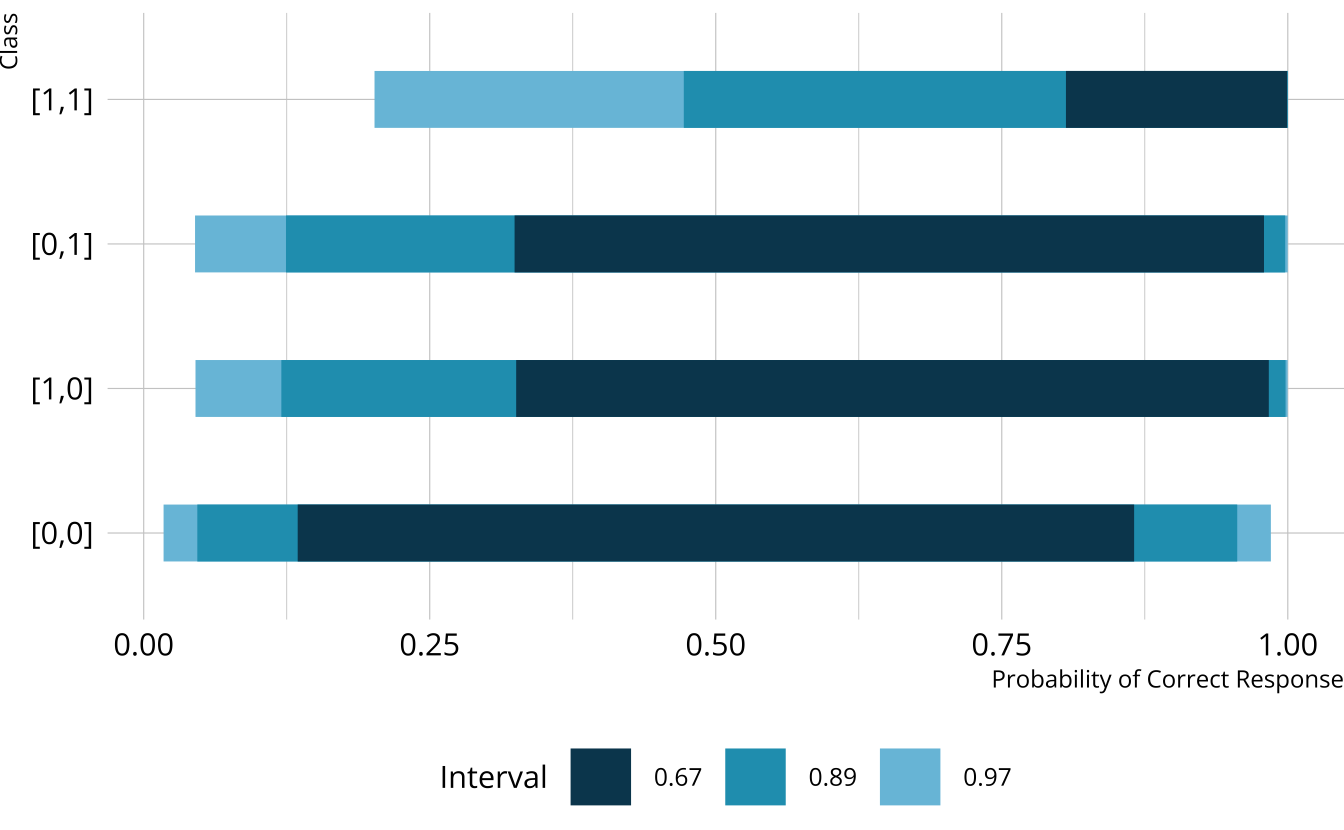
Creating custom priors
Specifying custom priors
new_spec
#> A loglinear cognitive diagnostic model (LCDM) measuring 3 attributes with 28
#> items.
#>
#> ℹ Attributes:
#> • "morphosyntactic" (13 items)
#> • "cohesive" (6 items)
#> • "lexical" (18 items)
#>
#> ℹ Attribute structure:
#>   Unconstrained
#>
#> ℹ Prior distributions:
#>   intercept ~ normal(-1, 1)
#>   maineffect ~ lognormal(0, 5)
#>   interaction ~ normal(0, 2)
#>   `Vc` ~ dirichlet(1, 1, 1)
Extract priors
Exercise 4
Estimate a new LCDM model for the ROAR-PA data with the following priors:
- Intercepts:
normal(-1, 2)- Except item 3, which should use a
normal(0, 1)prior
- Except item 3, which should use a
- Main effects:
lognormal(0, 1)
Use method = "optim" for a speedier estimation
Extract the prior to see that the specifications were applied
new_roarpa <- dcm_estimate(
  dcm_spec = dcm_specify(
    qmatrix = roarpa_qmatrix,
    identifier = "item",
    measurement_model = lcdm(),
    priors = c(
      prior(normal(-1, 2), type = "intercept"),
      prior(normal(0, 1), type = "intercept", coefficient = "l3_0"),
      prior(lognormal(0, 1), type = "maineffect")
    )
  ),
  data = roarpa_data,
  identifier = "id",
  method = "optim",
  backend = "rstan",
  file = here("materials", "slides", "fits", "roarpa-new-prior")
)Estimating diagnostic classification models
With Stan and measr