Evaluating diagnostic
classification models
With Stan and measr
Model evaluation
Absolute fit: How well does the model represent the observed data?
- Model-level
- Item-level
Relative fit: How do multiple models compare to each other?
Reliability: How consistent and accurate are the classifications?
Absolute model fit
Model-level absolute fit
- Limited information indices based on parameter point estimates
- M2 statistic (Liu et al., 2016)
- Posterior predictive model checks (PPMCs)
Calculating limited information indices
Estimates model fit using univariate and bivariate item relationships
p-values less than .05 indicate poor fit
- Also includes the root mean square error of approximation (RMSEA) and the standardized root mean square residual (SRMSR)
Exercise 1
Open
evaluation.Rmdand run thesetupchunk.Calculate the M2 statistic for the ROAR-PA LCDM model
Does the model fit the data?
- The null hypothesis is that our model fits the data
- p-values > .05 indicate acceptable model fit
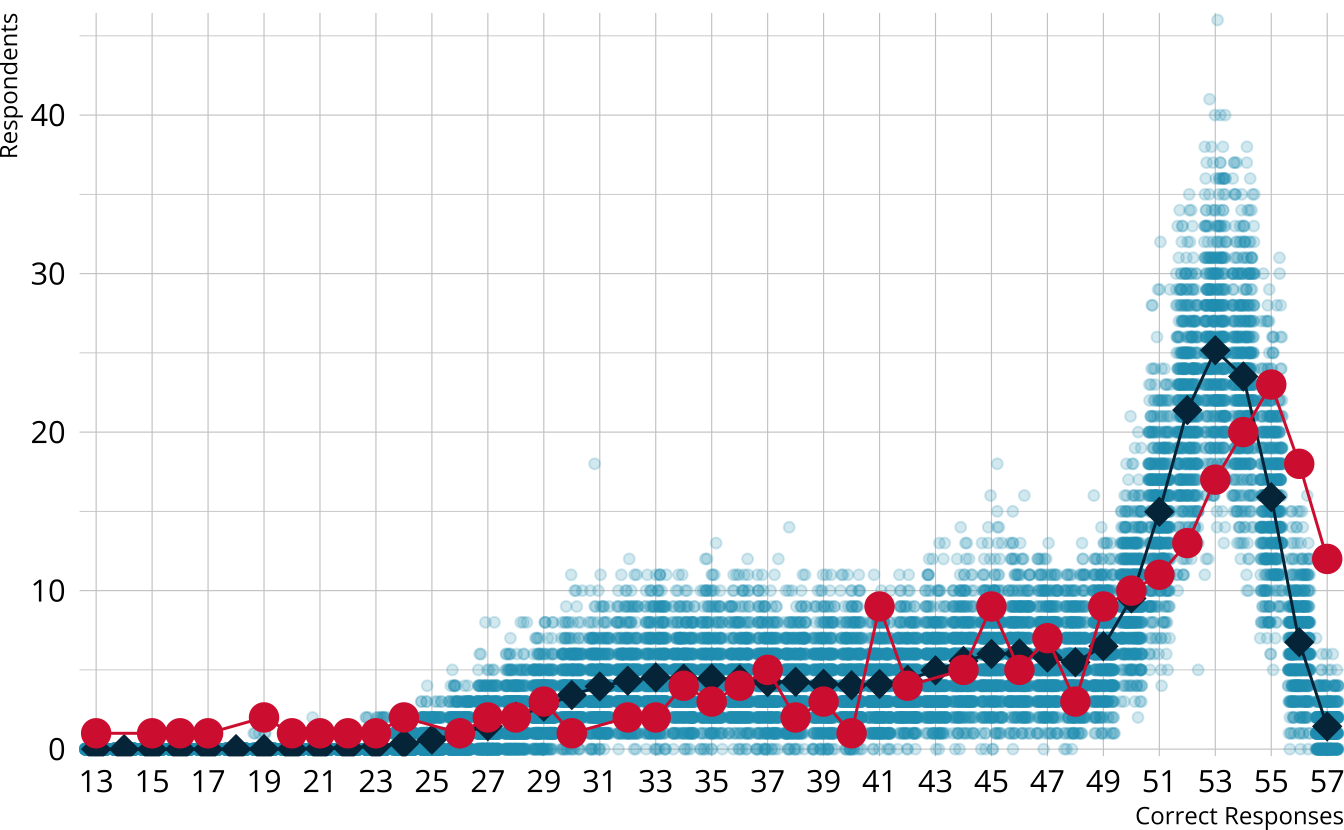
PPMC: Raw score distribution
- For each iteration, calculate the total number of respondents at each score point
- Calculate the expected number of respondents at each score point
- Calculate the observed number of respondents at each score point
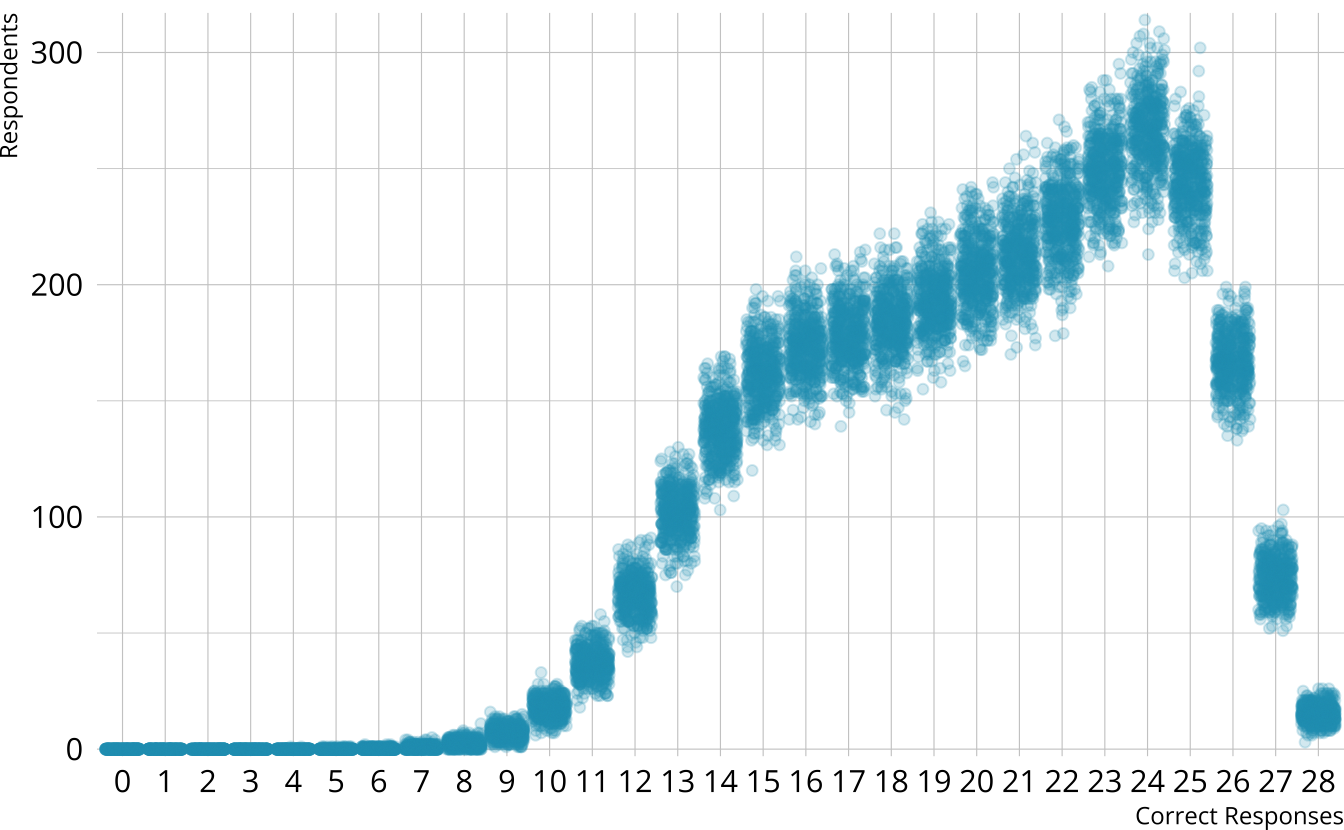
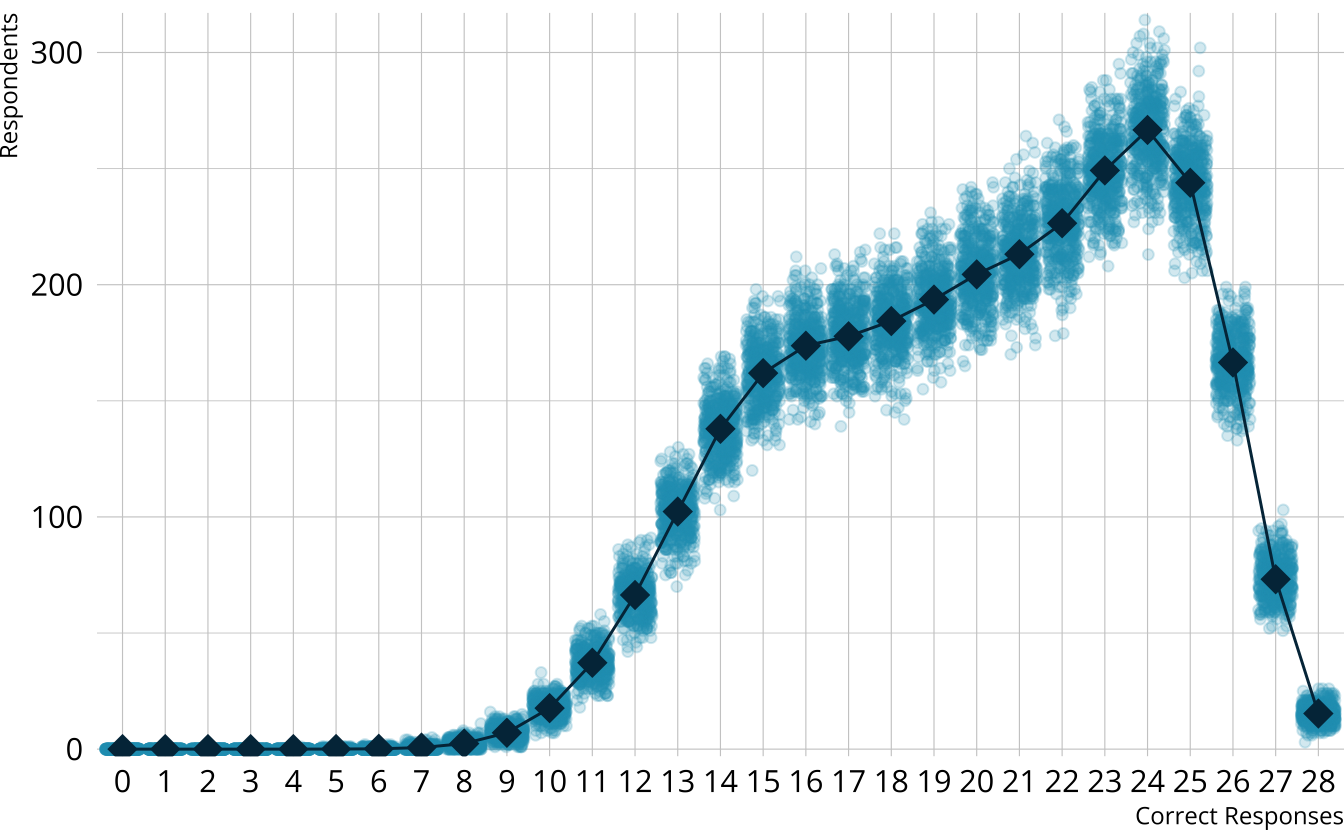
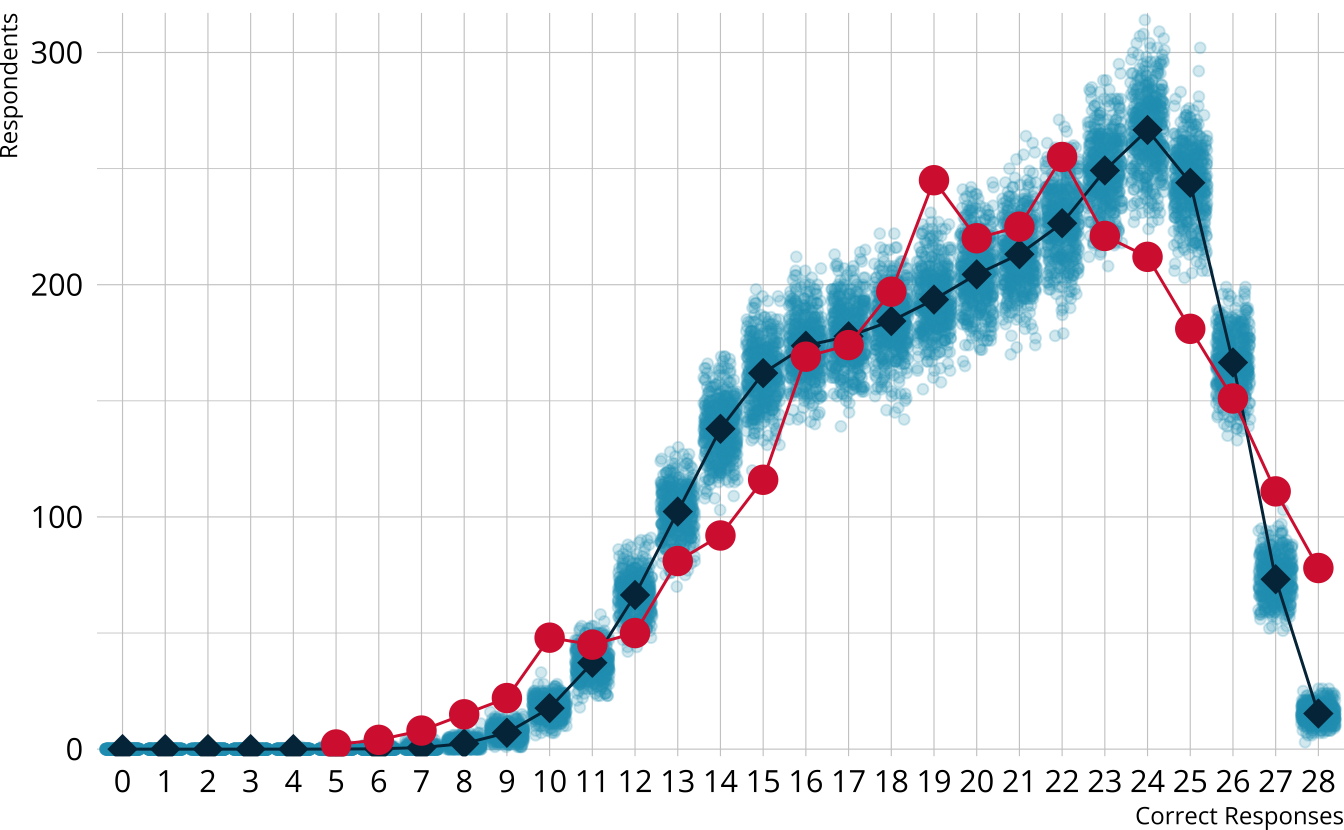
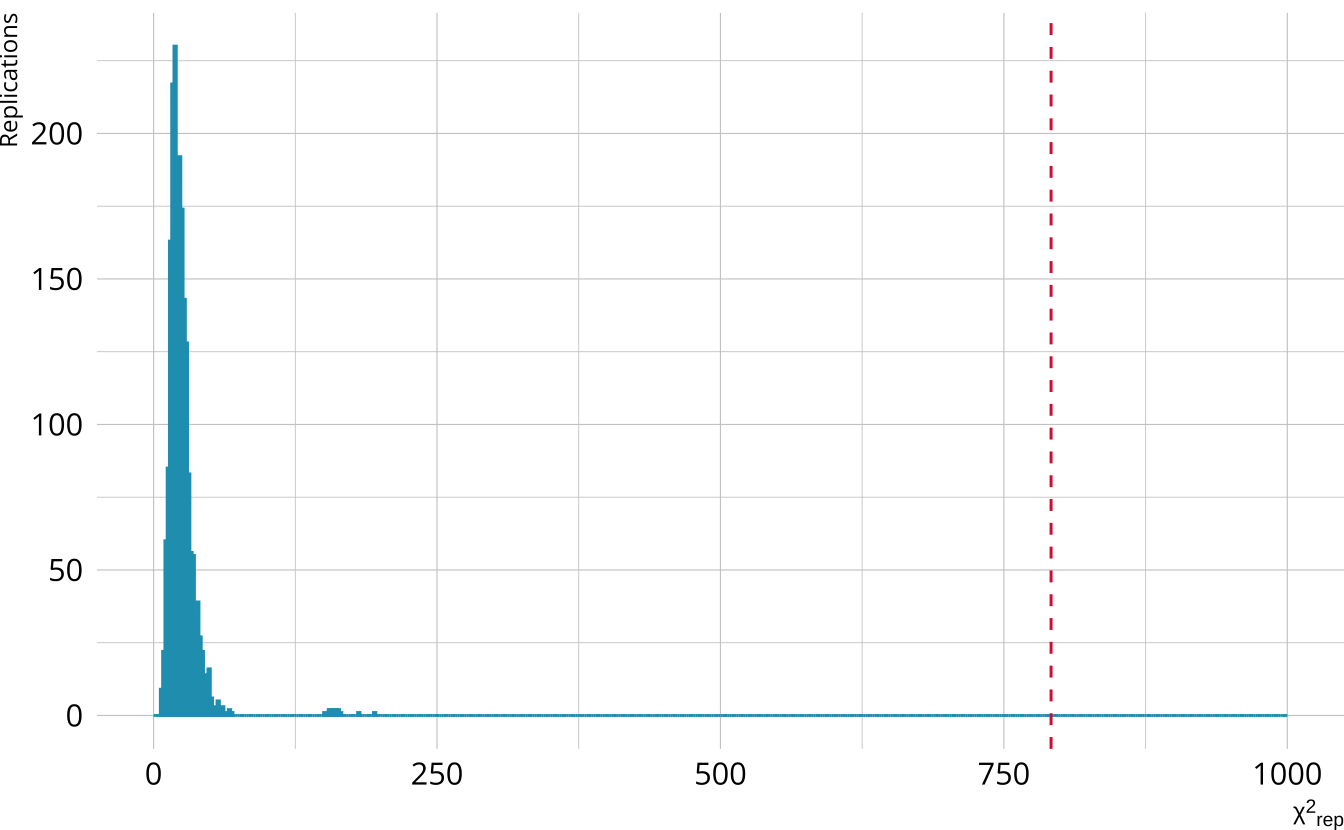
PPMC: \(\chi^2\)
- Calculate a \(\chi^2\)-like statistic comparing the number of respondents at each score point in each iteration to the expectation
- Calculate the \(\chi^2\) value comparing the observed data to the expectation
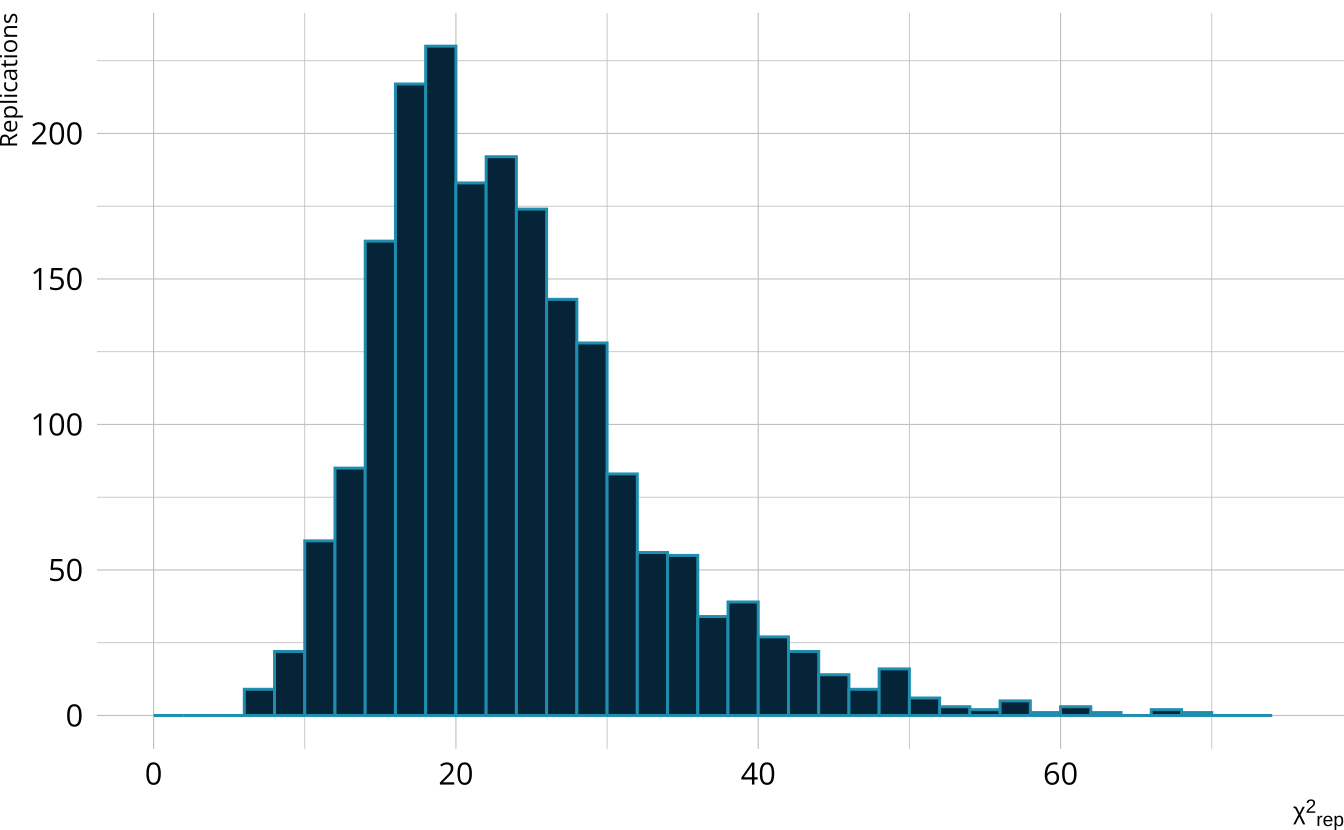
PPMC: ppp
- Calculate the proportion of iterations where the \(\chi^2\)-like statistic from replicated data set exceeds the observed data statistic
- Posterior predictive p-value (ppp)
- Very high values (e.g., >.975) or very low values (e.g., <.025) indicate our observed value is far in the tails of what the model would predict
- Poor model fit
- Ideally, we’d like ppp values close to .5
PPMCs with measr
Exercise 2
Calculate the raw score PPMC for the ROAR-PA LCDM
Does the model fit the observed data?
- The ppp value is <.001
- Model fit appears to be poor.
- Why the difference from the M2 conclusion?
ROAR-PA raw score distribution
- Model is underestimating the number of students with the highest scores
- M2 is limited information—we may miss aspects of the data that come from higher order interactions between items
Item-level fit
Diagnose problems with model-level
Identify particular items that may not be performing as expected
Identify potential dimensionality issues
Item-level fit with measr
- Currently support three measures of item-level fit using PPMCs:
- Overall item p-values
- Conditional probability of each class providing a correct response (\(\pi\) matrix)
- Item pair odds ratios
Calculating item-level fit
fit_ppmc(ecpe_lcdm, item_fit = "odds_ratio")
#> $ppmc_odds_ratio
#> # A tibble: 378 × 7
#>    item_1 item_2 obs_or ppmc_mean `2.5%` `97.5%`   ppp
#>    <chr>  <chr>   <dbl>     <dbl>  <dbl>   <dbl> <dbl>
#>  1 E1     E2       1.61      1.42   1.11    1.78 0.140
#>  2 E1     E3       1.42      1.56   1.27    1.86 0.810
#>  3 E1     E4       1.58      1.40   1.15    1.70 0.114
#>  4 E1     E5       1.68      1.47   1.10    1.89 0.159
#>  5 E1     E6       1.64      1.38   1.07    1.77 0.085
#>  6 E1     E7       1.99      1.89   1.55    2.30 0.286
#>  7 E1     E8       1.54      1.59   1.18    2.06 0.574
#>  8 E1     E9       1.18      1.32   1.08    1.60 0.871
#>  9 E1     E10      1.82      1.69   1.37    2.04 0.220
#> 10 E1     E11      1.61      1.73   1.40    2.08 0.736
#> # ℹ 368 more rows
Extracting item-level fit
measr_extract(ecpe_lcdm, "ppmc_pvalue")
#> # A tibble: 28 × 7
#>    item_id obs_pvalue ppmc_mean `2.5%` `97.5%` samples          ppp
#>    <fct>        <dbl>     <dbl>  <dbl>   <dbl> <named list>   <dbl>
#>  1 E1           0.803     0.810  0.786   0.827 <dbl [2,000]> 0.798
#>  2 E2           0.830     0.831  0.815   0.846 <dbl [2,000]> 0.554
#>  3 E3           0.579     0.553  0.531   0.591 <dbl [2,000]> 0.0885
#>  4 E4           0.706     0.697  0.680   0.716 <dbl [2,000]> 0.167
#>  5 E5           0.887     0.886  0.873   0.900 <dbl [2,000]> 0.419
#>  6 E6           0.854     0.854  0.839   0.868 <dbl [2,000]> 0.512
#>  7 E7           0.721     0.708  0.690   0.733 <dbl [2,000]> 0.118
#>  8 E8           0.898     0.900  0.888   0.912 <dbl [2,000]> 0.626
#>  9 E9           0.702     0.695  0.675   0.719 <dbl [2,000]> 0.239
#> 10 E10          0.658     0.670  0.640   0.690 <dbl [2,000]> 0.844
#> # ℹ 18 more rows
Flagging item-level fit
measr_extract(ecpe_lcdm, "ppmc_conditional_prob_flags")
#> # A tibble: 142 × 8
#>    item_id class   obs_cond_pval ppmc_mean `2.5%` `97.5%` samples          ppp
#>    <chr>   <chr>           <dbl>     <dbl>  <dbl>   <dbl> <named list>   <dbl>
#>  1 E1      [0,0,0]         0.701     0.695  0.672   0.699 <dbl [2,000]> 0.0055
#>  2 E1      [1,0,0]         0.664     0.822  0.795   0.827 <dbl [2,000]> 1
#>  3 E1      [0,0,1]         0.582     0.695  0.672   0.699 <dbl [2,000]> 1
#>  4 E1      [1,1,0]         1         0.941  0.930   0.942 <dbl [2,000]> 0
#>  5 E1      [1,0,1]         0.617     0.822  0.795   0.827 <dbl [2,000]> 1
#>  6 E1      [0,1,1]         0.854     0.813  0.791   0.819 <dbl [2,000]> 0
#>  7 E1      [1,1,1]         0.928     0.941  0.930   0.942 <dbl [2,000]> 0.98
#>  8 E2      [1,0,0]         0.803     0.741  0.730   0.744 <dbl [2,000]> 0
#>  9 E2      [0,0,1]         0.712     0.741  0.730   0.744 <dbl [2,000]> 0.991
#> 10 E2      [1,1,0]         1         0.908  0.907   0.913 <dbl [2,000]> 0
#> # ℹ 132 more rowsmeasr_extract(ecpe_lcdm, "ppmc_odds_ratio_flags")
#> # A tibble: 78 × 8
#> item_1 item_2 obs_or ppmc_mean `2.5%` `97.5%` samples ppp
#> <chr> <chr> <dbl> <dbl> <dbl> <dbl> <named list> <dbl>
#> 1 E1 E17 2.02 1.50 1.13 1.94 <dbl [2,000]> 0.0155
#> 2 E1 E26 1.61 1.29 1.05 1.57 <dbl [2,000]> 0.014
#> 3 E1 E28 1.86 1.43 1.13 1.77 <dbl [2,000]> 0.0075
#> 4 E2 E4 1.73 1.35 1.09 1.65 <dbl [2,000]> 0.0055
#> 5 E2 E5 1.84 1.40 1.03 1.83 <dbl [2,000]> 0.024
#> 6 E2 E6 1.72 1.33 1.00 1.72 <dbl [2,000]> 0.024
#> 7 E2 E14 1.64 1.24 1.01 1.51 <dbl [2,000]> 0.002
#> 8 E2 E15 1.92 1.45 1.07 1.90 <dbl [2,000]> 0.02
#> 9 E4 E5 2.81 2.06 1.63 2.58 <dbl [2,000]> 0.0065
#> 10 E4 E8 2.14 1.48 1.13 1.90 <dbl [2,000]> 0.0005
#> # ℹ 68 more rowsPatterns of item-level misfit
measr_extract(ecpe_lcdm, "ppmc_conditional_prob_flags") |>
  count(class, name = "flags") |>
  left_join(measr_extract(ecpe_lcdm, "strc_param"), by = join_by(class)) |>
  arrange(desc(flags))
#> # A tibble: 7 × 6
#>   class   flags morphosyntactic cohesive lexical         estimate
#>   <chr>   <int>           <int>    <int>   <int>       <rvar[1d]>
#> 1 [1,0,1]    27               1        0       1  0.020 ± 0.00097
#> 2 [1,0,0]    26               1        0       0  0.018 ± 0.00198
#> 3 [0,0,1]    25               0        0       1  0.133 ± 0.00517
#> 4 [1,1,0]    23               1        1       0  0.015 ± 0.00253
#> 5 [0,1,1]    21               0        1       1  0.154 ± 0.00909
#> 6 [0,0,0]    12               0        0       0  0.291 ± 0.00588
#> 7 [1,1,1]     8               1        1       1  0.350 ± 0.00487
Exercise 3
Calculate PPMCs for the conditional probabilities and odds ratios for the ROAR-PA model
What do the results tell us about the model?
measr_extract(roarpa_lcdm, "ppmc_conditional_prob_flags") |>
  count(class, name = "flags") |>
  left_join(measr_extract(roarpa_lcdm, "strc_param"), by = join_by(class)) |>
  arrange(desc(flags))
#> # A tibble: 8 × 6
#>   class   flags   lsm   del   fsm        estimate
#>   <chr>   <int> <int> <int> <int>      <rvar[1d]>
#> 1 [1,0,0]    54     1     0     0  0.011 ± 0.0083
#> 2 [1,0,1]    42     1     0     1  0.042 ± 0.0162
#> 3 [1,1,0]    39     1     1     0  0.037 ± 0.0151
#> 4 [0,0,1]    38     0     0     1  0.059 ± 0.0198
#> 5 [0,1,0]    31     0     1     0  0.047 ± 0.0169
#> 6 [0,1,1]    24     0     1     1  0.099 ± 0.0228
#> 7 [0,0,0]    11     0     0     0  0.158 ± 0.0269
#> 8 [1,1,1] 2 1 1 1 0.546 ± 0.0400measr_extract(roarpa_lcdm, "ppmc_odds_ratio_flags")
#> # A tibble: 164 × 8
#> item_1 item_2 obs_or ppmc_mean `2.5%` `97.5%` samples ppp
#> <chr> <chr> <dbl> <dbl> <dbl> <dbl> <named list> <dbl>
#> 1 fsm_01 lsm_07 7.20 2.84 0.956 6.59 <dbl [2,000]> 0.016
#> 2 fsm_01 lsm_08 5.84 2.47 0.839 5.72 <dbl [2,000]> 0.023
#> 3 fsm_01 lsm_19 0.349 2.44 0.378 6.30 <dbl [2,000]> 0.978
#> 4 fsm_01 del_09 12.3 3.21 0.731 8.22 <dbl [2,000]> 0.003
#> 5 fsm_01 del_15 7.81 2.57 0.520 6.49 <dbl [2,000]> 0.0115
#> 6 fsm_04 fsm_11 13.6 4.38 0 13.1 <dbl [2,000]> 0.019
#> 7 fsm_04 del_01 11 2.31 0 8.20 <dbl [2,000]> 0.012
#> 8 fsm_04 del_07 7.75 Inf 0 6.44 <dbl [2,000]> 0.0105
#> 9 fsm_04 del_09 14.0 Inf 0 8.99 <dbl [2,000]> 0.0045
#> 10 fsm_04 del_16 5.08 1.80 0 5.00 <dbl [2,000]> 0.0235
#> # ℹ 154 more rowsRelative model fit
Model comparisons
- Doesn’t give us information whether or not a model fits the data, only compares competing models to each other
- Should be evaluated in conjunction with absolute model fit
- Implemented with the loo package
- PSIS-LOO (Vehtari, 2017)
- WAIC (Watanabe, 2010)
Relative fit with measr
loo(ecpe_lcdm)
#>
#> Computed from 2000 by 2922 log-likelihood matrix.
#>
#>          Estimate    SE
#> elpd_loo -42794.9 226.8
#> p_loo        23.4   0.4
#> looic     85589.7 453.7
#> ------
#> MCSE of elpd_loo is NA.
#> MCSE and ESS estimates assume independent draws (r_eff=1).
#>
#> Pareto k diagnostic values:
#>                          Count Pct.    Min. ESS
#> (-Inf, 0.7]   (good)      749  25.6%   1897
#>    (0.7, 1]   (bad)        13   0.4%   <NA>
#>    (1, Inf)   (very bad) 2160  73.9%   <NA>
#> See help('pareto-k-diagnostic') for details.

waic(ecpe_lcdm)
#>
#> Computed from 2000 by 2922 log-likelihood matrix.
#>
#>           Estimate    SE
#> elpd_waic -42794.8 226.8
#> p_waic        23.3   0.4
#> waic       85589.5 453.7
Comparing models
First, we need another model to compare
ecpe_dina_spec <- dcm_specify(
  qmatrix = ecpe_qmatrix,
  identifier = "item_id",
  measurement_model = dina(),
  structural_model = unconstrained()
)

ecpe_dina <- dcm_estimate(
  ecpe_dina_spec,
  data = ecpe_data,
  identifier = "resp_id",
  method = "pathfinder",
  backend = "cmdstanr",
  single_path_draws = 1000,
  num_paths = 10,
  draws = 2000,
  file = here("materials", "slides", "fits", "ecpe-dina-uncst")
)
loo_compare()
- LCDM is the preferred model
- Preferred does not imply “good”
- Remember, the LCDM showed poor absolute fit
- Difference is much larger than the standard error of the difference
- Approximate threshold: Absolute difference is greater than 2.5 × standard error of the difference (Bengio & Grandvalet, 2004)
Exercise 4
Estimate a DINA model for the ROAR-PA data
Use
loo_compare()to compare the LCDM and DINA models- What do the findings tell us?
- Can you explain the results?
roarpa_dina_spec <- dcm_specify(
  qmatrix = roarpa_qmatrix,
  identifier = "item",
  measurement_model = dina(),
  structural_model = unconstrained()
)

roarpa_dina <- dcm_estimate(
  roarpa_dina_spec,
  data = roarpa_data,
  identifier = "id",
  method = "variational",
  backend = "rstan",
  seed = 19891213,
  file = here("materials", "slides", "fits", "roarpa-dina-uncst")
)Reliability
Reliability methods
Reporting reliability depends on how results are estimated and reported
Reliability for:
- Profile-level classification
- Attribute-level classification
- Attribute-level probability of proficiency
Reliability with measr
reliability(ecpe_lcdm)
#> $pattern_reliability
#>       p_a       p_c
#> 0.7357164 0.6525172
#>
#> $map_reliability
#> $map_reliability$accuracy
#> # A tibble: 3 × 8
#>   attribute         acc lambda_a kappa_a youden_a tetra_a  tp_a  tn_a
#>   <chr>           <dbl>    <dbl>   <dbl>    <dbl>   <dbl> <dbl> <dbl>
#> 1 morphosyntactic 0.896    0.734   0.789    0.780   0.943 0.864 0.916
#> 2 cohesive        0.851    0.678   0.700    0.699   0.891 0.870 0.829
#> 3 lexical         0.916    0.752   0.603    0.805   0.959 0.945 0.859
#>
#> $map_reliability$consistency
#> # A tibble: 3 × 10
#>   attribute       consist lambda_c kappa_c youden_c tetra_c  tp_c  tn_c gammak
#>   <chr>             <dbl>    <dbl>   <dbl>    <dbl>   <dbl> <dbl> <dbl>  <dbl>
#> 1 morphosyntactic   0.818    0.534   0.710    0.618   0.828 0.767 0.850  0.852
#> 2 cohesive          0.800    0.560   0.688    0.597   0.807 0.817 0.780  0.788
#> 3 lexical           0.864    0.583   0.635    0.690   0.890 0.899 0.791  0.880
#> # ℹ 1 more variable: pc_prime <dbl>
#>
#>
#> $eap_reliability
#> # A tibble: 3 × 5
#>   attribute       rho_pf rho_bs rho_i rho_tb
#>   <chr>            <dbl>  <dbl> <dbl>  <dbl>
#> 1 morphosyntactic  0.706  0.689 0.577  0.885
#> 2 cohesive         0.707  0.574 0.506  0.785
#> 3 lexical          0.776  0.731 0.588  0.916
Profile-level classification
measr_extract(ecpe_lcdm, "class_prob")
#> # A tibble: 2,922 × 9
#>    resp_id `[0,0,0]` `[1,0,0]` `[0,1,0]` `[0,0,1]` `[1,1,0]` `[1,0,1]` `[0,1,1]`
#>    <chr>       <dbl>     <dbl>     <dbl>     <dbl>     <dbl>     <dbl>     <dbl>
#>  1 1         5.21e-6   1.27e-4   4.15e-7  0.00127  0.000118   0.0472     0.00171
#>  2 2         5.10e-6   1.25e-4   2.20e-7  0.00352  0.0000636  0.130      0.00156
#>  3 3         5.59e-6   1.87e-5   2.23e-6  0.00315  0.0000902  0.00959    0.0211
#>  4 4         2.02e-7   4.94e-6   8.07e-8  0.000264 0.0000230  0.00981    0.00178
#>  5 5         6.73e-4   9.61e-3   2.69e-4  0.00112  0.0450     0.00920    0.00752
#>  6 6         1.93e-6   1.70e-5   7.70e-7  0.000840 0.0000795  0.00977    0.00566
#>  7 7         1.93e-6   1.70e-5   7.70e-7  0.000840 0.0000795  0.00977    0.00566
#>  8 8         2.62e-2   7.33e-5   1.09e-3  0.571    0.0000203  0.000295   0.400
#>  9 9         4.77e-5   3.05e-4   1.91e-5  0.00606  0.00147    0.00935    0.0408
#> 10 10        2.60e-1   5.98e-1   2.02e-3  0.0331   0.0556     0.0161     0.00432
#> # ℹ 2,912 more rows
#> # ℹ 1 more variable: `[1,1,1]` <dbl>measr_extract(ecpe_lcdm, "class_prob") |>
pivot_longer(-resp_id, names_to = "profile", values_to = "prob") |>
slice_max(order_by = prob, by = resp_id)
#> # A tibble: 2,922 × 3
#> resp_id profile prob
#> <chr> <chr> <dbl>
#> 1 1 [1,1,1] 0.950
#> 2 2 [1,1,1] 0.864
#> 3 3 [1,1,1] 0.966
#> 4 4 [1,1,1] 0.988
#> 5 5 [1,1,1] 0.927
#> 6 6 [1,1,1] 0.984
#> 7 7 [1,1,1] 0.984
#> 8 8 [0,0,1] 0.571
#> 9 9 [1,1,1] 0.942
#> 10 10 [1,0,0] 0.598
#> # ℹ 2,912 more rows- Estimating classification consistency and accuracy for cognitive diagnostic assessment (Cui et al., 2012)
Attribute-level classification
measr_extract(ecpe_lcdm, "attribute_prob")
#> # A tibble: 2,922 × 4
#>    resp_id morphosyntactic cohesive lexical
#>    <chr>             <dbl>    <dbl>   <dbl>
#>  1 1               0.997     0.951   1.000
#>  2 2               0.995     0.866   1.000
#>  3 3               0.976     0.987   1.000
#>  4 4               0.998     0.990   1.000
#>  5 5               0.990     0.979   0.944
#>  6 6               0.993     0.989   1.000
#>  7 7               0.993     0.989   1.000
#>  8 8               0.00208   0.403   0.973
#>  9 9               0.953     0.984   0.998
#> 10 10              0.701     0.0932  0.0847
#> # ℹ 2,912 more rowsmeasr_extract(ecpe_lcdm, "attribute_prob") |>
mutate(across(where(is.double), \(x) as.integer(x > 0.5)))
#> # A tibble: 2,922 × 4
#> resp_id morphosyntactic cohesive lexical
#> <chr> <int> <int> <int>
#> 1 1 1 1 1
#> 2 2 1 1 1
#> 3 3 1 1 1
#> 4 4 1 1 1
#> 5 5 1 1 1
#> 6 6 1 1 1
#> 7 7 1 1 1
#> 8 8 0 0 1
#> 9 9 1 1 1
#> 10 10 1 0 0
#> # ℹ 2,912 more rows- Measures of agreement to assess attribute-level classification accuracy and consistency for cognitive diagnostic assessments (Johnson & Sinharay, 2018)
Attribute-level probabilities
measr_extract(ecpe_lcdm, "attribute_prob")
#> # A tibble: 2,922 × 4
#>    resp_id morphosyntactic cohesive lexical
#>    <chr>             <dbl>    <dbl>   <dbl>
#>  1 1               0.997     0.951   1.000
#>  2 2               0.995     0.866   1.000
#>  3 3               0.976     0.987   1.000
#>  4 4               0.998     0.990   1.000
#>  5 5               0.990     0.979   0.944
#>  6 6               0.993     0.989   1.000
#>  7 7               0.993     0.989   1.000
#>  8 8               0.00208   0.403   0.973
#>  9 9               0.953     0.984   0.998
#> 10 10              0.701     0.0932  0.0847
#> # ℹ 2,912 more rows- The reliability of the posterior probability of skill attainment in diagnostic classification models (Johnson & Sinharay, 2020)
Exercise 5
Examine the attribute classification indices for the ROAR-PA LCDM.
Which attributes are the most and least reliable?
Evaluating diagnostic classification models
With Stan and measr